Mostrando entradas con la etiqueta talent. Mostrar todas las entradas

jueves, 17 de marzo de 2016

Metafora przywództwa i prawo grawitacji

Przywództwo i rozwój organizacyjny: Najlepsze firmy przyciągnąć najlepszych talentów


Sir Ronald Cohen (1) mówi, że firma powinna przyciągnąć najlepszych talentów;  Sir Isaac Newton pokazały, że organy masowego odwołania w wyniku działania grawitacji na mniejsze (w praktyce zarówno przyciągać i dużych firm i talenty, wielkie i małe ciała niebieskie). Metafora ciężkości pomaga wyjaśnić związek między tymi dwoma pojęciami.


Sir Isaac Newton (2) stworzył podstawy mechaniki klasycznej. Grawitacja powoduje przyspieszenia odczuwanego przez ciało fizyczne w pobliżu ciała niebieskiego. Nazywana jest również oddziaływanie grawitacyjne lub grawitacji i została zaprezentowana w 1687 roku w książce Philosophiae Naturalis Principia Mathematica Principia. 

Newton mówi: "Ja wywnioskować, że siły, które utrzymują się w swoich orbitach planety musi być odwrotnie proporcjonalna do kwadratu ich odległości od centrów na obrót, a więc w porównaniu siły, by utrzymać się w jego orbicie Księżyca siła ciężkości na powierzchni Ziemi, znalazłem bardzo ścisłą odpowiedź .. "

Równanie jest następujące:


Gdzie F jest siłą pomiędzy masami, G to stała grawitacyjna (6,674 x 10-11 N • (m / kg) 2); M1 i M2 to masy interakcji obiektów; r jest odległością pomiędzy środkiem masy (jest bardziej skomplikowane ekspresji, ale jest na tyle, aby zilustrować metaforę)
Punkt masa przyciąga masę każdego punktu obiektu przez życie, które jest zgodne z linią, która przecina oba punkty. Ta siła jest proporcjonalna do iloczynu obu mas, a odwrotnie proporcjonalna do kwadratu odległości pomiędzy nimi. Poniższy schemat ilustruje tę interakcję.


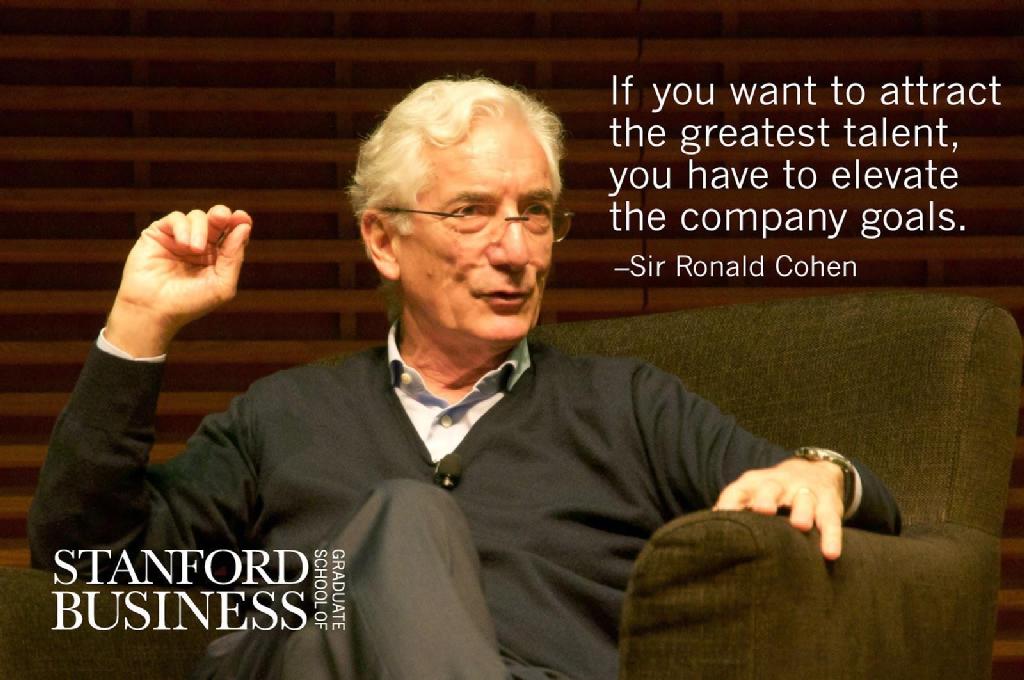
Ronald Cohen w rozmowie z Stanford Graduate School powiedział, że aby przyciągnąć najlepszych pracowników do organizacji, muszą wzrosnąć cele i stworzyć możliwości dla rzeczy, aby przyczynić się do poprawy społeczeństwa. Call "siła przyciągania" do intensywności, z jaką organizacja staje mogą przyciągnąć talenty. Aby zrozumieć swoją wizję zaleca się przeczytać "rewolucjonizuje Filantropia: Inwestowanie Impact".

Zasada podstawowa i mądry, ale jak to odnosi się do prawa grawitacji?. Dla organizacji, aby osiągnąć wielkie cele przyciągnąć najlepszych specjalistów i korpus z masą wywiera większą atrakcją małych ciał (wysoka ciężkości) wymagane są pewne warunki.

Zależność między wczesnym i Newton Cohen
Prawo grawitacji (Newton)
Zasada Cohen
F = siła ciężkości
F= siła atrakcyjności
G= stała uniwersalna grawitacyjna
G= stała atrakcyjności organizacyjnej (musi być dodatnia)
m1= masa ciała większej, m2 = masa ciała mniejszej
m1= wizji i zasad organizacji , m2= wizja i zasada talentu (osób)
r = odległość pomiędzy masami
r = stopień rozbieżności między zasad, wartości i celów organizacji oraz osoby
Źródło : C. Rivas R./2016

W odniesieniu do "mas", tym bardziej podobne i tym podobne są zasady i cele organizacji i talentów, nie może być bardziej intensywne podejście i wreszcie talent dołącza do organizacji, gdzie masz szansę na rozwój i można wykazać i zastosować swoje umiejętności i kompetencje. Etyki może być jednym z nich.

Odległość R równa się rozbieżności lub sprzeczności pomiędzy zasad, wartości i celów obu organizacji i utalentowanych ludzi. W tym przypadku, wydaje się, że większe masowe (M1> M2) i odległość R rozbieżność jest zmniejszona.

Ważny szczegół. W przeciwieństwie do prawa Newtona jest niezmienna, przynajmniej w naszych obecnych warunkach kosmicznych, prawo atrakcyjności (pomiędzy organizacją i talentu) może się zmienić. Można zwiększyć masę lub odległości. Jeśli talent, który jest spójny i wierny swoim zasadom, odkrywa, że ​​organizacja jest sprzeczne swoje zasady i nie spełnia ich oczekiwań, czuje się bardziej odległe do niej, a może dać (siła przyciągania osłabia).


W organizacji z charakterystyką Cohen w celu utrzymania stałej lub zwiększenie siły F, musi być organizator zdolny do tworzenia i utrzymywania tych warunków. Można powiedzieć, że oprócz bycia liderem, musi działać jako demiurga (3) twórczej duszy, architekta lub uniwersalnej duszy, która jest naczelną zasadą istniejących wcześniej elementów.

Przykładem przywództwa również zauważyć w komunikacie i dbałością o opinie. W przeciwieństwie do menedżerów, chciwych i uzależniony od pieniędzy, takich jak Wall Street, Jeff Weiner, CEO LinkedIn zrezygnował z rocznej premii (14 milionów dolarów w akcje) do dystrybucji swoich pracowników. (Dla rzeczy jak ty został wybrany najlepszym CEO w 2014 roku i jest jednym z najbardziej cenionych przez ich pracowników), to nie ma znaczenia, jeśli tylko raz, co robi, ale dał lekcję przywództwa dotąd niepublikowanych. A talent chce pracować z nim, oczywiście.

Noty
1) Isaac Newton (Woolsthorpe, Lincolnshire, 25 grudnia 04 stycznia 1642jul./ 1643greg.-Kensington, Londyn ,. 20 marca 1727greg jul./ 31 marca) był fizyk, filozof, teolog, wynalazca, angielski alchemik i matematykiem. On jest autorem Philosophiae Naturalis Principia Mathematica, lepiej znany jako Principia, opisując prawo powszechnego ciążenia, a podwaliny mechaniki klasycznej przez prawa, które noszą jego imię.

2) Sir Ronald Cohen Mourad (urodzony 01 sierpnia 1945) to brytyjski biznesmen pochodzenia egipskiego i figury politycznej. On jest prezesem Prezes Portland Trust i Mosty Ventures. Jest znany jako "ojciec brytyjskiego kapitału podwyższonego ryzyka" i "ojciec inwestycji społecznych".

3) Demiurg (gr Δημιουργός, demiurgów) w gnostyckiej filozofii, jest podmiotem, bez konieczności bycia kreatywnym doprowadza wszechświat. Jest również uważany za twórcę półbogiem świata i autor wszechświata w idealistycznej filozofii Platona i mistyką z neoplatoników. Dlatego demiurg dosłownie znaczy "mistrz rzemieślnik najwyższy, wykonawcą", chociaż podkreślając Greek oznaczałoby "stwórcy".


Referencje

Isaac Newton

Philosophiæ Naturalis Principia Mathematica


Ronald Mourad Cohen

Sir Ronald Cohen: Imapct investing in the future

domingo, 13 de marzo de 2016

Leadership and Metaphor of the law of gravity

Leadership and organizational development: The best companies attract the best talents


Sir Ronald Cohen (1) says that the best company should attract talents; as Sir Newton showed that the bodies of mass appeal by the action of gravity to smaller (in practice both attract, large companies to talents, big celestial bodies to small them). The metaphor of gravity helps explain the relationship between the two concepts.


Sir Isaac Newton (2) created the foundations of classical mechanics. Gravity causes the acceleration experienced by a physical body in the vicinity of a celestial body. It is also called gravitational interaction or gravitation and was presented in 1687 in the book Principia Mathematica Philosophiae Naturalis Principia. Newton says: "I deduced that the forces which keep the planets in their orbits must be inversely related to the square of their distances from the centers on rotating, and therefore compared the strength to keep the Moon in its orbit the force of gravity on the surface of the Earth, I found a very close answer .. "

The equation is as follows:


Where F is the force between the masses, G is the gravitational constant (6.674 × 10⁻¹¹ N • (m / kg) 2); m1 and m2 are the masses of interacting objects; r is the distance between the centers of mass (There is a more complex expression but this is enough to illustrate the metaphor)

A point mass attracts every single object point mass by a force that is aligned with the line that intersects both points. This force is directly proportional to the product of the two masses and inversely proportional to the square of the distance between them. The following diagram illustrates this interaction.


Ronald Cohen in an interview from the Stanford Graduate School said that top organizations to attract talent , they must rise goals and create opportunities for things to help improve society. Call "force of attractiveness” to the intensity with which the organization becomes can attract talents. To understand your vision is recommended to read "Revolutionizing Philanthropy: Impact Investing".

It is elementary and wise principle, but how it relates to the law of gravity? For an organization to achieve great goals and attract the best professionals and a body with mass exerts a greater attraction on small bodies (high gravity) certain conditions are required.


Relationship between early and Newton Cohen
Law of gravity (Newton)         Principle Cohen
F = force of gravity                   F = force of attractiveness
G = gravitational constant      G = constant universal organizational   attractiveness (must be positive)
m1 = mass of the larger body, m2 = mass of the smaller body                                              m1 = vision and principles of the organization, m2 = vision and principle of talent (people)
r = distance between the masses     r = degree of discrepancy between the principles, values ​​and goals of the organization and the person
Source: C. Rivas R./2016

In relation to the "masses", the more similar and the like are the principles and goals of the organization and talents, there may be a more intensive approach and finally the talent joins the organization where they have the opportunity for development and can demonstrate and apply their skills and competencies. Ethics can be one of them.

The distance r equals the discrepancy or conflict between the principles, values ​​and goals of both the organization and talented people. In this case it appears that the greater the mass (m1> m2) discrepancy or distance r is reduced.


An important detail. Unlike Newton's law that is invariable, at least in our present cosmic circumstances, the law of the attractiveness (between organization and talent) can change. You can increase the mass or distance. If talent, which is consistent and loyal to his principles,  discovers that the organization contradicts its principles and does not meet their expectations, feels more distant to her, and can abandon it  (the force of attraction weakens).

In an organization with the characteristics of Cohen to maintain constant or increasing force F, there must be an organizer capable of creating and maintaining these conditions. We could say that besides being a leader, must act as a demiurge (3) the creative soul, the architect or universal soul that is the guiding principle of pre-existing elements.

An example of leadership is also noted in the release and attention to reviewers. Unlike executives, greedy and addicted to money, such as in Wall Street, Jeff Weiner, CEO of LinkedIn waived his annual bonus ($ 14 million in shares) to distribute to their employees. (For things how are you was chosen as the best CEO in 2014 and is one of the most valued by their workers) it does not matter if the only time he does, but gave a lesson in leadership so far unpublished. And a talent want to work with him, certainly.

Notes
1) Isaac Newton (Woolsthorpe, Lincolnshire, 25 December 4 January 1642jul./ 1643greg.-Kensington, London,. March 20 1727greg jul./ March 31) was a physicist, philosopher, theologian, inventor, English alchemist and mathematician. He is the author of Philosophiæ Naturalis Principia Mathematica, better known as the Principia, describing the law of universal gravitation and laid the foundations of classical mechanics by laws that bear his name.
2) Sir Ronald Cohen Mourad (born August 1, 1945) is a British businessman of Egyptian origin and political figure. He is president of president of The Portland Trust and Bridges Ventures. It is known as "the father of British venture capital" and "the father of social investment."
3) The Demiurge (Greek: Δημιουργός, demiurges), in Gnostic philosophy, is the entity without necessarily being creative is driving the universe. It is also considered a demigod creator of the world and author of the universe in the idealistic philosophy of Plato and the mysticism of the Neoplatonists. Therefore, demiurge literally means "master craftsman supreme, doer", although emphasizing the Greek would mean "creator".

Referencias

Isaac Newton

Philosophiæ Naturalis Principia Mathematica


Ronald Mourad Cohen

Sir Ronald Cohen: Imapct investing in the future